Material
Aluminum 7075 Parts
Aluminum that thinks it’s steel.
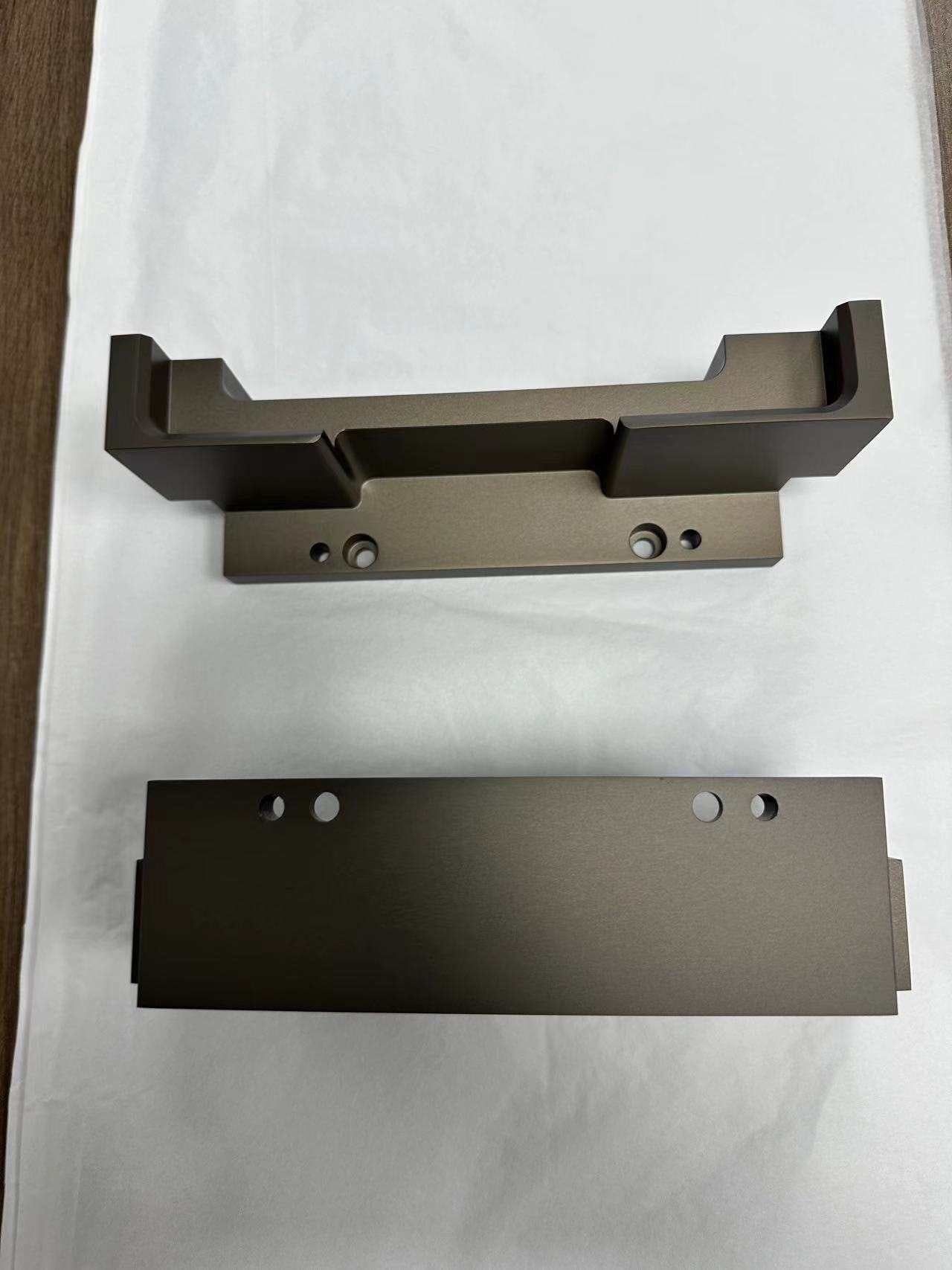
7075 is the aluminum you spec when 6061 isn’t strong enough: about 73 ksi yield in T651, nearly double the typical yield of 6061-T6, at roughly a third the density of steel. It suits high-load brackets, motorsport and robotics hardware, and parts that earn their keep under stress. Upload a STEP file and PDF drawing through the quote form (any file type is accepted) for a quote in 24-48 hours.
Updated October 2026
Aluminum 7075
Nearly double the yield of 6061-T6, at about a third the density of steel. Name it when the load case demands it.
Typical parts
- High-load brackets
- Motorsport hardware
- Robotics arms & links
- Aerospace-style fittings
Strength is the whole point
7075 is a zinc-alloyed aluminum, developed in Japan in 1935 and used for airframes (source 1). In the T651 temper (solution heat-treated, stress relieved by stretching and artificially aged, source 7) it is listed at 500 MPa (73 ksi) yield and 570 MPa (83 ksi) tensile, and thicker plate may read lower (source 1). Typical yield for 6061-T6 is 270 MPa (39 ksi) (source 2), so 7075-T651 is nearly double. Source 1 also describes 7075 as resistant to fatigue. Parts that yield or bend under load in 6061 are the usual candidates for 7075, because yield strength is the number that changes. At 2.81 g/cm³ (source 1) it is about a third the density of A36 structural steel at 7.8 g/cm³ (source 3). The 6061 vs 7075 comparison sets the two alloys side by side.
One honest caveat: stiffness. The elastic modulus is 71.7 GPa for 7075 and 69 GPa for 6061 (sources 1 and 2), against 200 GPa for A36 steel (source 3). A part that deflects too much in 6061 will deflect nearly as much in 7075: it simply takes more load before it permanently bends. If your problem is flex, change the geometry; if your problem is yielding or fatigue, change the alloy.
Where it gets used
Source 1 lists 7075 in transport applications (marine, automotive and aviation) for its high specific strength, and in rock climbing equipment, bicycle components and off-road motorcycle crankcase guards. The machined parts that suit it are high-load brackets and mounts, robot arms and end-effector plates, motorsport hardware, and weight-critical parts that would otherwise be steel. The pattern is consistent: the loads are real, every gram is counted, and the part is bolted, not welded, into the assembly. It is quoted like any aluminum job, from one-off prototypes to repeat batches.
The fine print
7075 is hard to fusion weld. A 2019 University of California, Los Angeles study in Nature Communications names hot cracking (solidification and liquation cracking) as what has kept arc welding of 7075 from succeeding (source 4); 6061, by contrast, is described as highly weldable (source 2). Design bolted, pinned, or press-fit joints, or use 6061 if welding is non-negotiable.
Copper, iron and silicon significantly lower the corrosion resistance of aluminum alloys, and the source puts the 2000, 4000, 6000 and 7000 series in the most susceptible group (source 5); 7075 carries 1.2-1.6% copper (source 1). 7075 is also vulnerable to stress corrosion cracking (source 1). The overaged T7 temper, equivalent to T73, reduces that susceptibility at lower strength: 435 MPa (63 ksi) yield against 500 MPa (73 ksi) for T651 (source 1). If your part sees sustained stress in a corrosive setting, name the alloy and temper on the print.
The alloy is one thing that shapes a quote and the geometry is another, which is where design choices that raise a quote picks up.
Finishes
Type II anodize in clear or black is a common protective callout. Type II is a moderate-thickness sulfuric-acid coating and Type III hardcoat is thicker, and coating thickness raises wear resistance (source 5), so name Type III on the print where surfaces slide or wear. A finish called out on the print is quoted with the part. Dyed colors tend to vary with the base alloy (source 5), so dyed 7075 may not match dyed 6061 side by side. Note it on the print if an exact shade matters across mixed-alloy assemblies.
Sources
All accessed 4 October 2026. Where a figure here differs from your print, the print governs.
1. Wikipedia, “7075 aluminium alloy”: en.wikipedia.org (developed by Sumitomo Metal in 1935 and used for airframe production; 1.2-1.6% copper; T651 at 570 MPa tensile and 500 MPa yield, thicker plates may read lower; T6 yield at least 430-480 MPa; T7, equivalent to T73, 435 MPa yield and reduced stress corrosion cracking susceptibility; resistance to fatigue; vulnerable to stress corrosion cracking; density 2.81 g/cm³; Young’s modulus 71.7 GPa; uses in transport, climbing equipment, bicycle components and crankcase guards).
2. Wikipedia, “6061 aluminium alloy”: en.wikipedia.org (6061-T6 typical yield 270 MPa (39 ksi); Young’s modulus 69 GPa; highly weldable).
3. Wikipedia, “A36 steel”: en.wikipedia.org (density 7.8 g/cm³; Young’s modulus 200 GPa).
4. Sokoluk, Cao, Pan and Li, University of California, Los Angeles, “Nanoparticle-enabled phase control for arc welding of unweldable aluminum alloy 7075”, Nature Communications 10, 98, January 2019: pmc.ncbi.nlm.nih.gov (hot crack susceptibility during fusion welding a long-standing issue for 7075; solidification and liquation cracking the two dominant hot crack modes; 6061 a less crack-susceptible material).
5. Wikipedia, “Anodizing”: en.wikipedia.org (copper, iron and silicon significantly decrease the corrosion resistance of aluminium alloys, with 2000-, 4000-, 6000 and 7000-series most susceptible; anodizing thickens the protective oxide layer; Type II sulfuric acid coatings of moderate thickness, Type III thicker hard anodizing; thickness increases wear resistance; dye colors tend to vary according to the base alloy).
6. Wikipedia, “Machinability”: en.wikipedia.org (aluminium alloys do not tend to form built-up edges, so they rank as more machinable than materials that do).
7. Wikipedia, “Aluminium alloy”: en.wikipedia.org (temper designations: -T6 solution heat-treated and artificially aged; -T651 solution heat-treated, stress relieved by stretching, and artificially aged).
Questions
Before you send a job.
01 How much stronger is 7075 than 6061?
In the T651 temper, 7075 is listed at 500 MPa (73 ksi) yield against a typical 270 MPa (39 ksi) for 6061-T6, nearly double (sources 1 and 2). Stiffness is nearly unchanged (71.7 against 69 GPa), so 7075 resists permanent bending, not flex. A part that needs to deflect less needs different geometry, not a different aluminum.
02 Can 7075 be welded?
Not easily. Fusion welding 7075 has long been held back by hot cracking, solidification and liquation cracking (source 4), so plan on bolts, dowels or press fits. If the part will be welded, 6061 is described as highly weldable (source 2).
03 Does 7075 need to be anodized?
Not always. Copper, which 7075 carries at 1.2-1.6% (source 1), significantly lowers the corrosion resistance of aluminum alloys, and anodizing thickens the protective oxide layer (source 5). If the part will see moisture or weather, put anodize on the print. Type II is a common callout; Type III hardcoat where parts slide or wear.
04 Does 7075 machine like other aluminum alloys?
Aluminum alloys as a group do not tend to form a built-up edge, which ranks them among the more machinable materials (source 6); the quote works from the alloy and temper on the print. Tolerances are the usual: ±0.005 in typical, ±0.001 in on critical turned diameters, and milled features quoted from the print.
05 What does T651 mean on a 7075 callout?
T651 is the temper designation for solution heat-treated, stress relieved by stretching and artificially aged (source 7). Source 1 lists 7075-T6 yield at no less than 430-480 MPa (63-69 ksi) and T651 at 500 MPa (73 ksi), and notes thicker plate may read lower. The T6 range is a minimum and the T651 figure a listed value, so they are not a like-for-like comparison. Put the alloy and temper on the print; the print governs.
06 When should I just use 6061?
When the part is welded, when it sits under sustained stress in a wet or corrosive setting (7075 is vulnerable to stress corrosion cracking, source 1), when it’s deflection-limited (7075 won’t stiffen it), or when the stress math doesn’t demand 7075. 6061 is described as highly weldable (source 2). Other alloys and plastics quoted on request. Name the grade on the print.
Related
Where to go next.
Aluminum 6061
The default alloy, in full detail.
View →CNC Milling
Brackets, plates, and housings quoted from your files.
View →Rush Parts
When the broken bracket is holding up the build.
View →Custom Brackets
Replacement and one-off brackets, in 7075 or other aluminum.
View →Get a Quote
Send the files. Numbers back in 24-48 hours.
View →Get Started
Send us your files.
We’ll take it from there.
A quote in 24-48 hours, no minimums. Like the quote, and we’ll make your parts and ship them to you.
Get a Quote