Part Type
Replacement & One-Off Brackets
The bracket that broke, and the one that exists nowhere in a catalog.
A replacement or one-off bracket is the one no catalog carries: the wrong hole pattern, angle or thickness, or the one that just broke on a machine that is down. It gets made from solid in aluminum, steel or stainless to your print, with no minimum order. Send a STEP and PDF through the quote form, or a dimensioned sketch and a new sample part, for a quote in 24-48 hours. The sample ships back with the parts. The full range is on custom CNC brackets.
Updated October 2026
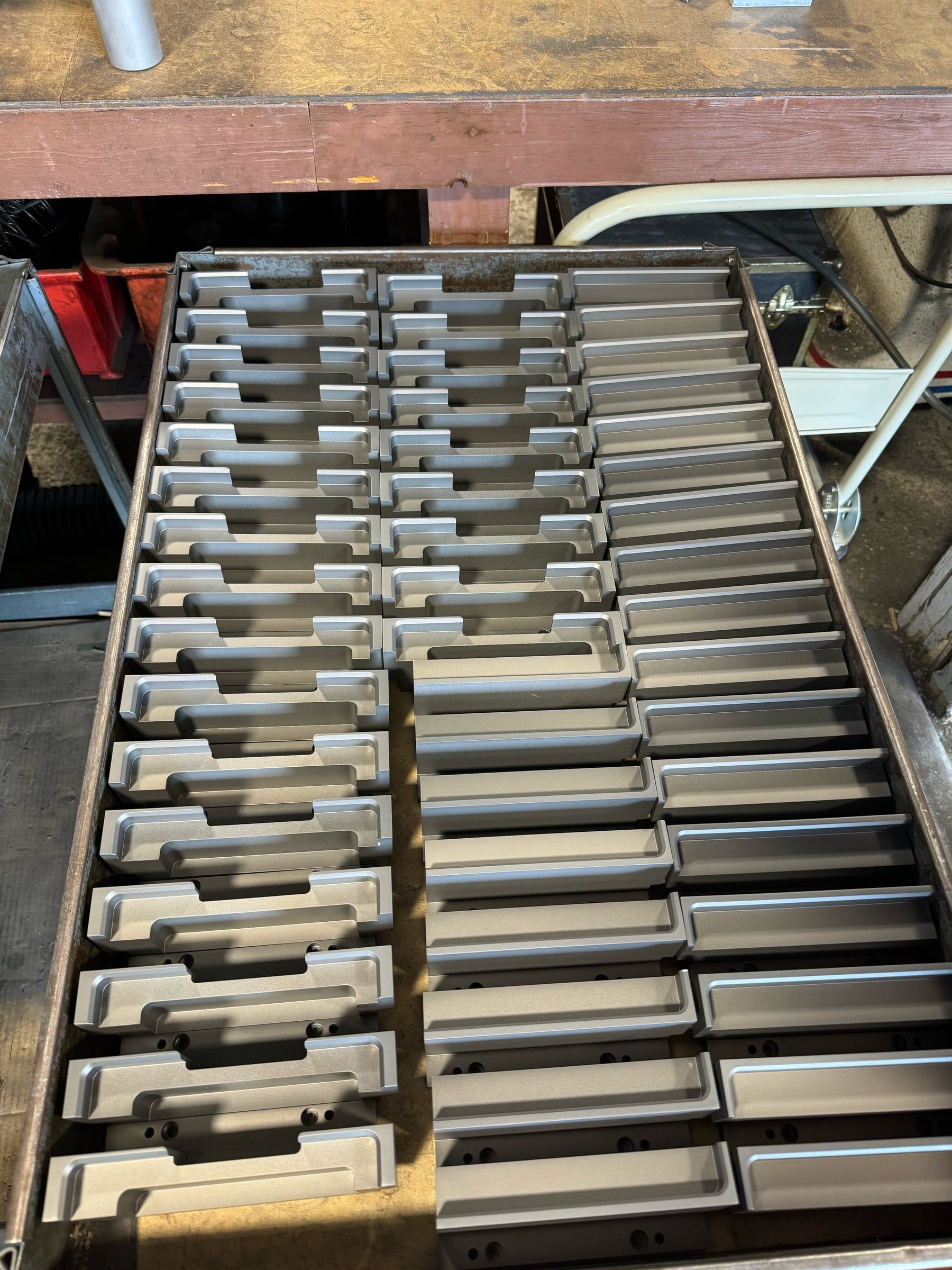
Machined or bent: a note for replacements
A replacement bracket is quoted the way the print draws it. If the bracket needs thick or tapped bosses or more than one thickness, it is milled from solid. A plain tab with two holes may suit bent sheet better, and the quote says so. The full comparison, with sourced bend figures, is on custom CNC brackets. Cast parts are not quoted, either as a casting or as a machined replacement for a part that was originally cast.
Picking the material
A replacement usually starts from the original’s material: 6061 aluminum, 7075, steel, 304 stainless or Delrin (acetal), named on the print with its temper. If the old bracket took a permanent bend, a stronger alloy helps: 7075-T6 yields at 430-480 MPa, against at least 240 MPa for 6061-T6 (sources 1 and 2). If it only flexed, a stronger alloy does not help. The two have nearly the same modulus, 69 and 71.7 GPa (sources 1 and 2), so the fix is a deeper section or a rib.
What to put on the print
The details that make a bracket right the first time: datum faces and a hole-pattern callout (GD&T can allow over 50% more tolerance zone than coordinate dimensioning in some cases, so a position tolerance beats a grid of ±0.005 dimensions, source 4), tapped versus clearance for every hole, slots where adjustment is wanted, and a note about which surfaces mate against other parts. Position, perpendicularity and runout callouts are quoted from the print. If the part that broke is a fixture plate, a plate drilled on a grid of tapped and dowel holes that holds parts during machining or assembly, it has its own page: aluminum fixture plates.
Load notes help more than they look like they should. “This carries a 40 lb motor with chain tension” tells the team what matters, so a thin section can be flagged before material is bought and the quote lands right the first time.
Finishes
Put the original’s finish on the print. Anodize grows each surface of an aluminum bracket by about half the coating thickness, so mark any bore or thread that has to fit after finishing (source 3). Powder coat suits steel, stainless or aluminum brackets that need a color. Name passivation per ASTM A967 on the print; name citric or nitric only if your spec requires one. Any bracket can also be left as machined. A finish called out on the print is quoted with the part. If the same assembly needs standoffs or a housing, they can go on one quote from the custom machined parts range.
Sources
All accessed 4 October 2026. Where a figure here differs from your print, the print governs.
1. Wikipedia, "6061 aluminium alloy": en.wikipedia.org/wiki/6061_aluminium_alloy (T6 yield at least 240 MPa (35 ksi); modulus 69 GPa).
2. Wikipedia, "7075 aluminium alloy": en.wikipedia.org/wiki/7075_aluminium_alloy (T6 yield 430-480 MPa; modulus 71.7 GPa).
3. Wikipedia, "Anodizing": en.wikipedia.org/wiki/Anodizing (the oxide grows into and out from the surface by equal amounts, so half the coating thickness is added per surface).
4. Wikipedia, "Geometric dimensioning and tolerancing": en.wikipedia.org/wiki/Geometric_dimensioning_and_tolerancing (over 50% more tolerance zone than coordinate dimensioning in some cases).
Questions
Before you send a job.
01 What files are needed to quote a bracket?
A STEP file for the geometry and a PDF print for tolerances, threads, and finish is the ideal package, and quotes come back in 24-48 hours from those. A fully dimensioned 2D PDF is quoted without a CAD line. No CAD at all? A sketch with dimensions, or a new sample bracket, is enough to start; modeling it from the sketch or the sample is quoted as its own line.
02 How fast can a replacement bracket be made?
Rush: 1-2 weeks. Standard: 4-6 weeks (typical). Extended: 6-8 weeks, for jobs that aren't time-sensitive. Rush is quoted at a premium. Rush 1-2 weeks applies to machined parts with no secondary operations. Heat treat, grinding, EDM and finishing add time, and the quote gives the real date. Lead time starts at order approval. Put your need date in the part description and the quote answers it. A bracket that goes the laser-cut and bent route is quoted per job, rush available. The rush CNC parts page covers the choice in full.
03 What tolerances are realistic on a machined bracket?
±0.005 in on general dimensions is typical, and tighter hole positions and critical bores are quoted from the print. Put the tight numbers only on the holes and faces that locate something, and leave the outline at the general tolerance. CNC machining tolerances covers how they are read.
04 Can I order just one bracket?
One is a normal order; there is no minimum, and a single replacement bracket or a one-off prototype is quoted like any other part. Ask for more than one quantity, such as 1, 25 and 100, and the quote shows each. Reorders at the same revision: send the last quote or PO number and it’s requoted. One-off CNC machining covers the single-part order in more detail.
05 Which material should a replacement bracket be?
A replacement usually matches the original, so the print names the grade and temper (6061-T6, not just aluminum). If the old bracket bent or cracked, say so in the part description and the quote can point to a different grade. Other alloys and plastics quoted on request. Name the grade on the print.
06 Do material certifications ship with a replacement bracket?
No C of C or material certifications ship with parts by default. If your PO needs them, say so before the quote. Inspection reports on critical dimensions aren’t included by default. If you need one, ask when you place the order.
Related
Where to go next.
Custom CNC Brackets
The full bracket range, machined or cut and bent.
View →CNC Milling
The process behind most custom brackets.
View →Aluminum 6061
The default bracket material.
View →Rush Parts
When the broken bracket is holding up the build.
View →Get a Quote
STEP + PDF in, numbers back in 24-48 hours.
View →Get Started
Send us your files.
We’ll take it from there.
A quote in 24-48 hours, no minimums. Like the quote, and we’ll make your parts and ship them to you.
Get a Quote