Part Type
Custom Machined Aluminum Manifolds & Fluid Blocks
One block instead of a tangle of fittings and tube
A custom aluminum manifold consolidates a hydraulic, pneumatic, coolant, or vacuum circuit into one block of metal, with the galleries, cross-bores, and ports cut to your schematic instead of forced onto a catalog part. These are milled and drilled to print in 6061, 7075, stainless, or brass. Send a port map and a model through the quote form and a real person sends numbers back in 24-48 hours.
Updated September 2026
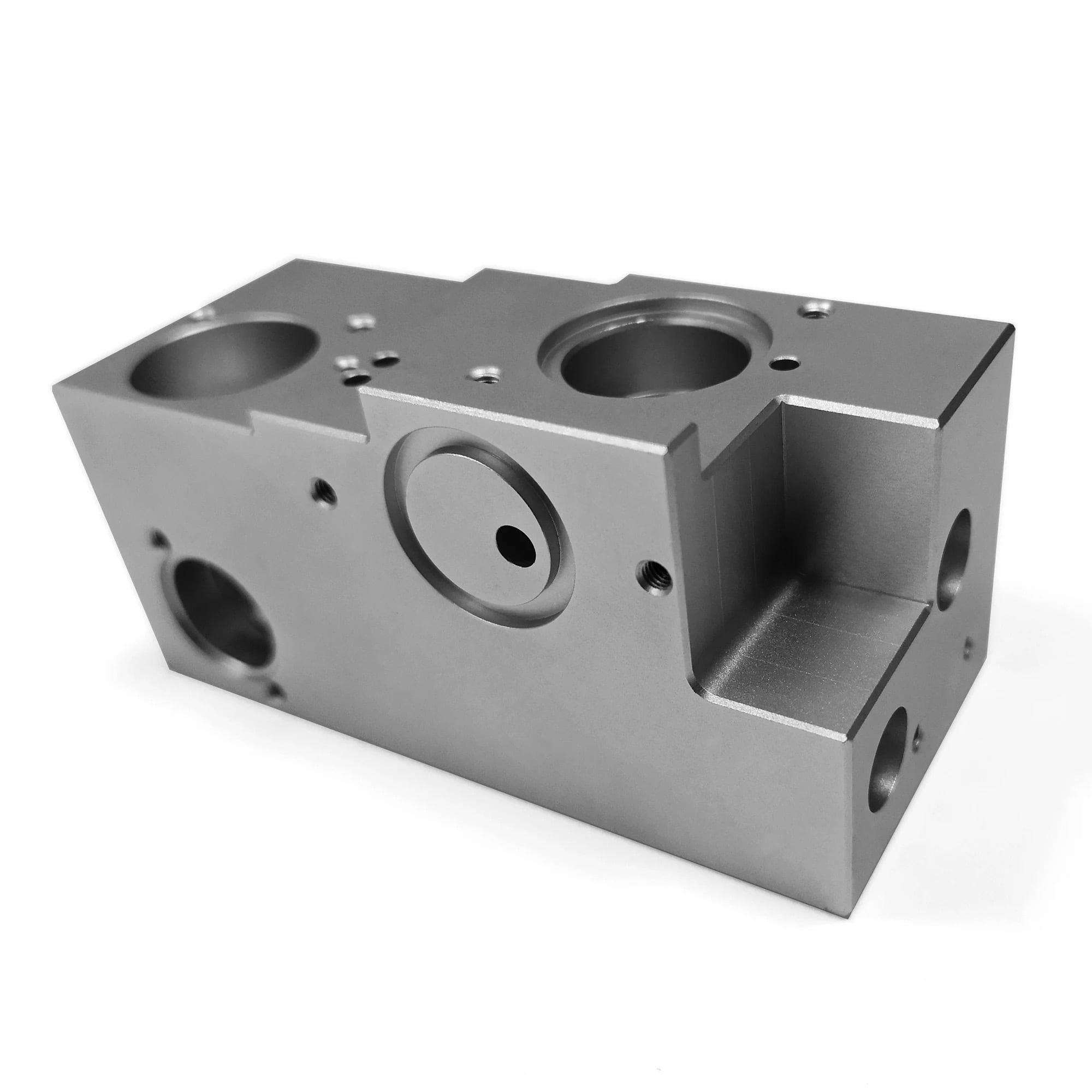
Why a custom block beats a stock manifold
Off-the-shelf manifolds are built around someone else’s port count, spacing, and circuit. The moment your layout needs an extra work port, a different thread, a gauge tap, or two valves talking to each other through an internal passage, the catalog part stops fitting and you are back to a nest of tees, elbows, and tube. Every one of those joints is one more place to leak and one more thing to assemble.
A hydraulic manifold is a block of metal with flow paths drilled through it, connecting various ports (source 2). Folding the schematic into one block removes joints: Mobile Hydraulic Tips describes a custom manifold that replaced 25 components with one and took a hydraulic circuit from 48 leak points to 9 (source 1). For round, ported bodies (a rotary union style hub or a barrel with radial ports) the same circuit can be turned rather than milled from a block.
Galleries, cross-bores, and deburring
The work inside a manifold is the drilling. Main galleries run the length of the block and cross-bores connect them.
Where two bores intersect, they leave a sharp ragged edge. A Cutting Tool Engineering article on deburring manifolds quotes an interviewed company president saying a burr that works loose “could cut seals, block valves,” and calling loose burrs “generally the single biggest failure mode for any hydraulic system” (source 3). Call out deburring on the print when a passage feeds a sensitive valve or a clean fluid circuit. A deburring note is quoted from the print, and the team will flag any intersection that is hard to reach before the block is cut.
Port threads and where each one seals
Port choice drives how well the manifold seals and how easy it is to plumb, because the common port threads seal in different places. The table covers three common callouts. ORB and NPT can look similar on a model but are not interchangeable, so spell out the exact callout per port.
| Port callout | Where it seals | What the print should name |
|---|---|---|
| NPT | A tapered thread, 1 in of diameter in 16 in of length. The flanks of the thread compress against each other as it is torqued; sealants, where used, are typically tape or paste (source 4). | NPT, the size, and which ports are tapped. |
| NPTF (Dryseal) | The crest and root heights are adjusted for an interference fit, and it is designed to seal without PTFE tape (source 4). | NPTF, not NPT, when that is what the mating fitting is. |
| SAE straight-thread O-ring port (ORB, SAE J1926-1) | The thread holds the fitting; an O-ring compressed in a chamfered area makes the seal, not the thread (source 5). SAE J1926-1 sets the dimensions of inch-thread O-ring ports (source 6). | The port standard and dash size, for example “-8 ORB port, SAE J1926-1.” O-rings are not supplied. |
| Any other port | Named on the print with the thread, the size and how it seals. | The thread, the size, the sealing style, and a drawing of the mating fitting if there is one. |
Sealing faces and mounting
Where the manifold bolts to a valve, pump, or plate, that face is a sealing face. Put the gasket or O-ring groove, the flatness and surface finish callouts, and the bolt pattern on the print. Position, perpendicularity and runout callouts are quoted from the print.
Choosing material and what to send
For most hydraulic, pneumatic, and coolant blocks, 6061 aluminum is the usual starting point: it stays resistant to corrosion even when the surface is abraded (source 7). 7075 is a high-strength aluminum alloy, with a stress-corrosion tradeoff covered in the questions below (source 8). Stainless steel resists corrosion through a chromium-rich passive film (source 9), so it is the usual step up for corrosive media, salt, or washdown, and brass is widely used for valves, hose couplings and plumbing fittings (source 10). Say what runs through the block so the team can flag a material that does not suit it. Other alloys and plastics quoted on request. Name the grade on the print.
To quote, send a STEP model plus a schematic or a simple port map that names each port, its thread callout, and which passages connect to which. That review is free: the team reads the circuit, flags any drilling or sealing issue before you commit, and the same person handles the quote in 24-48 hours. The team can talk through flow paths and leak paths during that review.
Sources
All accessed 30 September 2026. Where a figure here differs from your print, the print governs.
1. Mary Gannon, "HIC custom manifold eliminates leaks", Mobile Hydraulic Tips, 12 April 2018: mobilehydraulictips.com (25 components replaced by one; leak points from 48 to 9).
2. Wikipedia, "Hydraulic manifold": en.wikipedia.org/wiki/Hydraulic_manifold (a block of metal with flow paths drilled through it, connecting various ports).
3. Alan Richter, "Explosive deburring ideal for complex parts", Cutting Tool Engineering, 15 August 2017: ctemag.com (a loose burr could cut seals and block valves; burrs where an oil hole meets a threaded hole; "the single biggest failure mode for any hydraulic system").
4. Wikipedia, "National pipe thread": en.wikipedia.org/wiki/National_pipe_thread (ASME B1.20.1; taper of 1 in of diameter in 16 in of length; flanks compress to seal when torqued; sealants typically tape or paste; NPTF is designed to seal without PTFE tape).
5. Wikipedia, "O-ring boss seal": en.wikipedia.org/wiki/O-ring_boss_seal (the O-ring in a chamfered area makes the seal; the thread does not).
6. SAE International, J1926/1, "Connections for General Use and Fluid Power: Ports and Stud Ends with ASME B1.1 Threads and O-Ring Sealing, Part 1: Threaded Port with O-Ring Seal in Truncated Housing", revised February 2010, abstract only: saemobilus.sae.org (dimensions for fluid power and general use ports with inch threads; the standard itself is not reproduced here).
7. Wikipedia, "6061 aluminium alloy": en.wikipedia.org/wiki/6061_aluminium_alloy (magnesium and silicon precipitation-hardened; resistant to corrosion even when the surface is abraded).
8. Wikipedia, "7075 aluminium alloy": en.wikipedia.org/wiki/7075_aluminium_alloy (zinc as the main alloying element; high strength; more susceptible to embrittlement; T7 tempers reduce stress-corrosion susceptibility at some cost in peak strength).
9. Wikipedia, "Stainless steel": en.wikipedia.org/wiki/Stainless_steel (chromium-rich passive film; molybdenum improves resistance to pitting corrosion; pitting most common with chloride ions).
10. Wikipedia, "Brass": en.wikipedia.org/wiki/Brass (used where corrosion resistance and low friction are needed, including plumbing, hose couplings and valves).
Questions
Before you send a job.
01 What do I need to send to get a custom manifold quoted?
A STEP model of the block plus a schematic or port map is the ideal package: the port map names each port, its thread and port standard, and which internal passages connect. A fully dimensioned 2D PDF that shows gallery routing and sealing faces is quoted without a CAD line. If all you have is a schematic or a sketch, the CAD work is quoted as its own line. A real person sends the quote back in 24-48 hours, and a free design review comes with it.
02 What is the difference between an ORB port and an NPT port on a manifold?
They seal in different places. NPT seals on a taper as the flanks of the thread compress (source 4), while an ORB port seals on an O-ring compressed in a chamfer and the thread only holds the fitting (source 5). So an ORB port is written with its port standard, SAE J1926-1 (source 6), and its dash size, and the O-ring is not supplied with the block. Write NPT or NPTF on a tapered port, since NPTF is designed to seal without tape (source 4).
03 Why do cross-bore burrs matter, and where are the worst ones?
Cutting Tool Engineering gives the case of an oil hole meeting a threaded hole: burrs in the thread crevices are the ones likely to get knocked off and contaminate the system (source 3). Mark those intersections on the print, and name any passage that feeds a sensitive valve or a clean circuit. A deburring note is quoted from the print, and the team tells you before the block is cut if an intersection is hard to reach.
04 Should the block be 6061 or 7075, and when does stainless make sense?
6061 stays resistant to corrosion even when the surface is abraded (source 7). 7075 is a high-strength alloy but is more susceptible to embrittlement than many other aluminum alloys, and its T7 tempers reduce stress-corrosion susceptibility at some cost in peak strength (source 8), so the choice is the environment as much as the load. Stainless steel is the step up for salt or washdown, and adding molybdenum improves resistance to pitting corrosion, the attack most common where chloride ions are present (source 9). The 316 page and the 6061 vs 7075 comparison have the grade detail.
05 What certifications or inspection paperwork come with a custom manifold?
Every block is inspected against its print before it ships. The quote does not state a pressure rating. No C of C or material certifications ship with parts by default. If your PO needs them, say so before the quote. Inspection reports on critical dimensions aren’t included by default. If you need one, ask when you place the order.
06 Can I order one manifold to prove out a circuit before a production run?
Yes, one piece is a normal order. Ask for more than one quantity, such as 1, 25 and 100, and the quote shows each. Lead time starts at order approval. Put your need date in the part description and the quote answers it. Fittings, bungs and flanges can go on the same quote: see custom fittings, weld-in bungs and flanges, or the parts index for the rest.
Get Started
Send us your files.
We’ll take it from there.
A quote in 24-48 hours, no minimums. Like the quote, and we’ll make your parts and ship them to you.
Get a Quote