Part Type
CNC Machined Aluminum Enclosures & Housings
A case built around your board, not the other way around.
A CNC machined aluminum enclosure is a case cut from solid billet, with internal bosses, milled pockets, and bored connector holes sized to your board instead of cast in a die. With no die there is no draft requirement, and a revision is a new toolpath from the new model. Send a STEP file and a PDF through the quote form for a quote in 24-48 hours, with no minimum order.
Updated October 2026
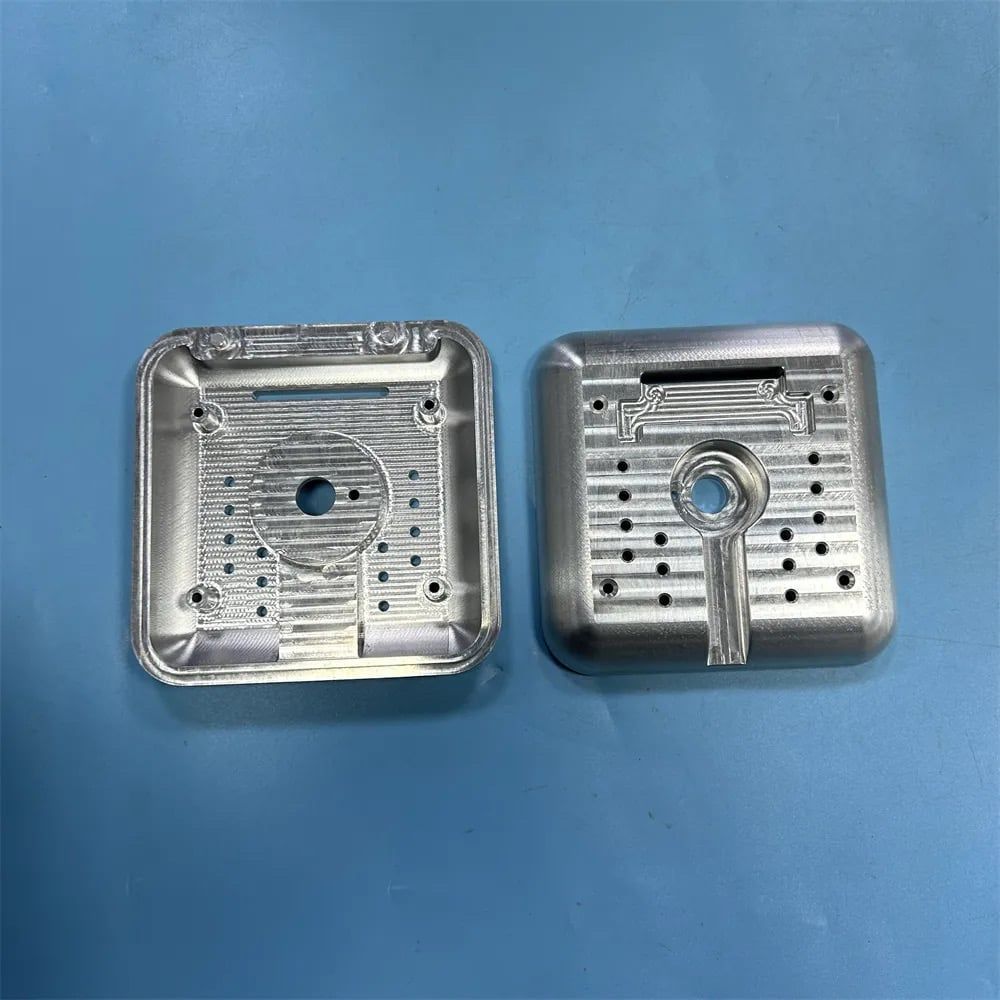
What a machined enclosure actually is
Most machined enclosures are a two-piece job: a base that holds the electronics and a lid that closes over it. The base gets milled pockets to clear the board, internal bosses tapped or counterbored for standoffs, bored holes for connectors and cable glands, and a flat sealing face around the rim. The lid carries its own pockets for display windows, buttons, and vents, plus the matching bolt pattern. Because every feature is cut from solid aluminum, walls, ribs, and mounting points go where the model puts them.
That is the difference from a plastic project box you drill out by hand. The connector openings, the standoff heights, and the PCB outline all live in one CAD model, so the print can carry every one of them. Grounding bosses, heat-sink pads, and gasket grooves are features of the part, not afterthoughts.
Machined from solid vs die-cast
Die casting is a process of forcing molten metal under high pressure into a mold cavity, and aluminum is one of the common alloys for it (source 1). Every die-cast surface parallel to the opening direction of the die needs draft so the casting can be ejected (source 1).
A machined enclosure is cut from solid, so there is no die to make before the first part and no draft requirement: walls stay vertical where the design wants them. When the board changes, a revision starts from the new model and a new toolpath. That is the difference to weigh for low-volume electronics enclosures and robotics housings, along with the quantity you need.
Materials, sealing, and finish
6061 aluminum is the usual starting point: it is one of the most common aluminum alloys for general-purpose use and stays resistant to corrosion even when the surface is abraded (source 4). Stainless resists corrosion through a thin passive film of chromium oxide (source 5), and the 316 stainless page covers the grade for chloride exposure. Other alloys and plastics quoted on request. Name the grade on the print.
For a gasket or O-ring seal, the groove and a flat sealing face are machined around the rim to the print. Put the groove width and depth, and the O-ring cross-section or gasket thickness, on the print instead of leaving a guessed slot.
Type II is a sulfuric-acid anodize that takes dye (source 2). The oxide grows into the surface and out from it by equal amounts (source 2), and powder coating can build a much thicker film than liquid paint (source 3), so say on the print whether a cutout dimension applies before or after finish. An anodized surface is insulating (source 2), so a face that must stay bare for grounding is marked on the print, and masking is quoted with the part. A finish called out on the print is quoted with the part.
What to put on the print
Connector and display cutouts are where fit is decided, so tolerance them on the print. Typical machined tolerance is ±0.005 in; tighter cutouts and mating faces are quoted from the print. A note on which face is the datum keeps the base and lid mating true. Position, perpendicularity and runout callouts are quoted from the print.
Spell out standoff and boss callouts: thread size, depth, and whether a threaded insert goes in after machining. If a boss needs a threaded insert, put it on the print; the insert is supplied and installed to the print. Name the wall thickness on the print, and say where a connector will be torqued so the free design review can look at that wall. An enclosure usually needs a bezel, a mounting bracket, or the knobs on its front panel to go with it, which the custom machined parts index covers.
Sources
All accessed 4 October 2026. Where a figure here differs from your print, the print governs.
1. Wikipedia, "Die casting": en.wikipedia.org/wiki/Die_casting (forcing molten metal under high pressure into a mold cavity; aluminium among the common non-ferrous alloys; surfaces parallel to the opening direction of the die require draft for ejection).
2. Wikipedia, "Anodizing": en.wikipedia.org/wiki/Anodizing (the anodic layer is insulative; the oxide grows into and out from the surface by equal amounts; sulfuric acid anodizing produces a porous surface that accepts dyes).
3. Wikipedia, "Powder coating": en.wikipedia.org/wiki/Powder_coating (can produce much thicker coatings than conventional liquid coatings without running or sagging).
4. Wikipedia, "6061 aluminium alloy": en.wikipedia.org/wiki/6061_aluminium_alloy (one of the most common aluminium alloys for general-purpose use; resistant to corrosion even when the surface is abraded).
5. Wikipedia, "Stainless steel": en.wikipedia.org/wiki/Stainless_steel (a thin surface film of chromium oxide; forms a passive film that protects the material and can self-heal when exposed to oxygen).
Questions
Before you send a job.
01 How is a machined enclosure different from a die-cast one?
A die-cast enclosure is formed by forcing molten metal under high pressure into a die (source 1), so the die has to exist before the first part. A machined enclosure is cut from solid billet to your model: there is no die to make, and a revision means a new toolpath from the new model. The walls differ too: die-cast surfaces need draft, and machined walls do not.
02 Can a machined aluminum enclosure take a gasket or O-ring seal?
Yes. The groove and the flat sealing face around the rim are machined to the print, so give the groove width, the groove depth, and the O-ring cross-section or gasket thickness. If the enclosure is anodized or powder coated, say on the print whether the sealing face is masked; masking is quoted with the part. The quote does not state an IP rating.
03 What tolerance should I put on connector cutouts?
Tolerance the cutouts and mating faces that set the fit, and let the drawing's general tolerance cover the outside walls. Typical machined tolerance is ±0.005 in, and tighter cutouts and mating faces are quoted from the print. Say whether the dimension applies before or after the finish: anodize grows into the surface and out from it by equal amounts (source 2), and powder coat builds a thicker film than liquid paint (source 3).
04 Do you need draft angles like a casting?
No. Die-cast surfaces parallel to the opening direction of the die need draft so the casting can be ejected (source 1). A machined enclosure has vertical walls cut straight from billet, so you keep the full internal volume and the standoff and boss positions stay where the CAD puts them.
05 What files do you need to quote an enclosure?
A STEP file of the base and lid plus a PDF drawing calling out cutout tolerances, gasket grooves, boss threads, and finish is the ideal package. A fully dimensioned 2D PDF is quoted without a CAD line, and a sketch, new sample part or photos start gets a quoted CAD line. Either way a real-person quote with price and lead time comes back in 24-48 hours.
06 Can one quote cover several quantities, with the base and lid together?
Yes. Ask for more than one quantity, such as 1, 25 and 100, and the quote shows each. The base and the lid are quoted together, each as its own part. Multi-part jobs can ship together or in stages; say which on the quote.
Related
Where to go next.
Get Started
Send us your files.
We’ll take it from there.
A quote in 24-48 hours, no minimums. Like the quote, and we’ll make your parts and ship them to you.
Get a Quote